Showing posts with label Millesime Bio. Show all posts

Tuesday, February 7, 2012

Wine from Italy's Organic Pioneers

Much of Europe is way ahead of the United States when it comes to the demand and supply of organic products.

Ivo Nardi, one of Italy’s leading organic wine producers, makes the Italian sparkling wine Prosecco and has become one of that nation’s organic farming method leaders.

Nardi’s Perlage label was one of 587 at Millesime Bio organic trade wine fair in Montpellier, France, Jan. 23-25. I attended the wine fair as part of a press trip sponsored by AIVB, the French Languedoc wine region trade association. 

The Millesime Bio is in its 19th year. It’s an international trade show allowing wineries to connect directly to importers from countries around the world. All participating wineries are certified organic by their national governing bodies to be eligible for participation.

Ivo Nardi, right, toasting sales manager Marcella Callegari.
Nardi and his brother Claudio have run Perlage since its founding in 1985. Prosecco is the far northeastern region about an hour from Venice. 

The Nardi brothers began to use organic farming techniques in their vineyards from the very beginning.  In 2005, Perlage began working in biodynamic agricultural practices.

A basic understanding of organic versus sulfite-free is necessary for U.S. consumers. The Food and Drug Administration has ruled, as recently as Dec. 2010, that wines sold in the U.S. can only be called organic if they are 100 percent sulfite free. Most European standards allow some use of sulfites to preserve the wine.
Therefore, a bottle of European wine will be labeled “produced with organically grown grapes” if it’s sold in the United States.  And that’s a point that doesn’t set well with European producers. Still, European organic growers use the absolute minimum sulfites needed.

Nardi insists the demand for organic products is higher in Europe than elsewhere.  He tells the story of selling 10,000 bottles of Perlage wines to a grocery chain in Holland. The buyers were reluctant worried if the product would sell. But the wines started flying off the shelves because the product was good – organic or not. That supermarket chain ended up selling 100,000 bottles in six months, Nardi said.

Nardi discussing his wines with importer Paul Chartrand
“We have a dream not just to be organic but that all of the production of DOCG Prosecco becomes organic within 3-4 years from now,” Nardi said. “We would like to increase our research on all of our production with the goal to reduce sulfites in all of our wines. The knowledge we gain helps with all of our wines.
“The philosophy in biodynamics is better responsibility and better relationship between man and the environment.”

But organic and biodynamic practices are difficult for farmers. They don’t use pesticides, herbicides, or any chemical products in the production of their wines. Cleanliness in handling the product, the exposure to oxygen, and cleanliness in bottling is far more critical than in traditional wine making processes.

During the Millesime Bio I tasted through the Perlage wines, particularly their Proseccos. We tasted the wonderful and groundbreaking Perlage Animae. It’s groundbreaking because it is 100 percent sulfite free. It was every bit as palate pleasing as the other four Prosecco wines we tasted. It retails in the U.S. for $29.99.

Prosecco is a delightfully affordable and refreshing sparkling wine made largely around the district of Valdobbiadene. Good Prosecco choices can be found from a variety of producers for less than $20. It has softer bubbles and a softer taste than many sparkling wines.

Perlage wines are widely available in the U.S. and imported by Chartrand Imports of Maine. Indiana’s Graybull Wines distributes Perlage. The label is also available in Illinois.

Perlage Sangiovese and two of its Prosecco sparklers are available in Indiana. Derek Gray said his biggest selling Perlage label is the Pinot Grigio.

Send comment or questions to: hewitthoward@gmail.com

Sunday, January 29, 2012

Thursday in Languedoc Countryside Was Trip's Highlight

Spending a full week in Southern France's Languedoc wine region was full of highlights. The week built to a full day out in the Languedoc countryside that really capped the week off.

I returned to Indiana Friday evening and have been recovering from the long flights. I have a lot of material to wade through. But I'm going to post some notes and build some albums as I got along.


Thierry Julien giving us a taste of Janiny wines.
Thursday was highlighted by a morning with Jacques Frelin who is a major figure in organic wine exporting to the U.S. His family is widely credited for starting the organic wine movement and starting the AIVB, the organic wine organization that sponsors the Millesime Bio wine fair.

Jacques took me to the 3 S bottling plant that serves many wineries in southern France and then on to Pezenas.

Thierry Julien's family also has a long history in organic vineyard practices. Julien is the current AIVB president.

The two shared candid thoughts about the perception of organic wine in the U.S. and why there remains much confusion. Their remarks are quite interesting. I'll be writing that story for Palate Press in coming weeks.

But I have a lot of material I can use in the newspaper column and elsewhere. And I have a lot of material that will eventually get posted here.

Here is a photo album built this morning from my Thursday in the Languedoc.
Send comment or questions to: hewitthoward@gmail.com

Tuesday, January 24, 2012

Young Guns Boosting Organic Wine Growth

MONTPELLIER, FRANCE – There are 587 wineries from around the world participating in the 19th Millesime Bio here and there seems to be just as many stories.

Men of 70 and 80 years old with domaine and chateau names which just sound historic are plentiful. But you also see the young guns. There are a substantial number of 30-something and even 20-something year old winemakers. Some are following in their father’s footsteps while others sought out the life of vineyard work and winemaking on their own.

Cyril Bonnet
Cyril Bonnet is a very young winemaker with a very long history. He is the seventh generation to make wine. Most of that history is in Champagne where his father and family still live making the iconic bubbly at Chateau Bonnet-Ponson. But Cyril wanted to go out on his own and now has Chateau Bonnet in Villaudric, just northwest of Toulouse.

Bonnet is one of those 587 producers trying to make a name for himself. He grows an odd little variety most outside of Southwestern France have never heard of before. He blends Negrette with other more common varietals and even makes a 100 percent Negrette wine.

Being a young winemaker at 28 with an obscure grape means marketing is important. He also is a believer in organic practices and is fully certified.

"It’s very, very important, to be exported to the clients and be here at Millesime Bio,” Bonnet said. “If you can’t come to this type of fair it’s impossible to make contact to customers. My father told me this one is important because it’s very professional, very simple and we love it.

“Maybe 30 years ago it was possible to make it just working in your vineyard with what you sell there at the farm. But now maybe 50 percent of the work is to go to find customers and the other 50 percent is to make a good wine.”

Bonnet is serious about organics and grew up knowing nothing else. His father started organic practices in Champagne in 1979. “My father is very sensitive to all ecology and puts more of an emphasis on being all organic. I agree with this position, but I don’t like the extreme side when it goes toward biodynamic.”

The wines were interesting. I liked the Negrette grape and it definitely has a different flavor profile. The wine was light on the palate and it made for very drinkable red table wine. Bonnet is producing about 2,200 cases of wine each year.

I was able to do 6 interviews and get a lot done today for future blogs, Palate Press, and the newspaper column. I am getting together with U.S. importer of organic wines Paul Chartrand, who works out of Maine, to taste our way through more wineries Wednesday.

Another Young Gun
Luigi Di Tuccio
Antica Enotria - Luigi Di Tuccio was handing the pouring, sales, and marketing chores mid afternoon at his family winery's table. He could also be described as a young guy. He was worked every aspect of the business with his father. His father was one of first in Italy's Puglia to make the move to organics and became a leader in the region.

The winery has some great varietals that aren't household names - Nero di Troia, Aglianico and white wine grape Falanghina. His wines are available on both coasts. The family makes approximately 8,000 cases annually.

Other stops ...

Romain Bouchard - Two young brothers with no real family history in the wine business decided to buy a winery that had gone out of business in the Chablis region. They are now making two Chablis and have found some success with wines being exported to New York.

Chateau de Fosse Seche - This fun young couple are making wines in trhe Loire Valley's famed Samur region. I tasted their Samur Chenin Blanc and found it not as light as others I'd enjoyed but sure tasty. They also had a very nice Cabernet Franc.

Sitios De Bodega - This started out as a case of mistaken identy. I was looking for a winery I would find later then the language barrier with a Spanish woman and my confusion gave us a laugh. I ended up tasting and liking her first vintage of Verdejo which I liked very much. Export manager Alejandra Sanz was a good sport, with pretty good English, in telling me about the new effort.

Domaine de Picheral - Boxed wine in France seems a pretty ridiculous opposites attract kind of thing. But I've seen lots of boxed wines at the fair. I approach with my typical Tew Parl Ongleah? "Do you speak English?" to get two shaing heads and plenty of laughs for the three of us. What the heck, we used hand signals and pointing - a universal language - to taste a pretty darn good Rose, and a rather forgettable red. It was fun.

Ploder-Rosenberg - Austrian winemaker Freddy Ploder was the most congenial host of the day. The short, stout man was an enthusiastic wine tour guide through is tasting. Sharing just the right amount of wine geek talk, history, and good humor. I liked the entire line. Chardonnay, Sauvignon Blanc ... with several of he wines done in different winemaking styles.

As I wrote yesterday, I visited quite a few more wineries but these were the most interesting stops. And I visited several and did interviews which will turn up in future writing.

Send comment or questions to: hewitthoward@gmail.com
Monday, January 16, 2012

A Full Immersion into Organic Wine World

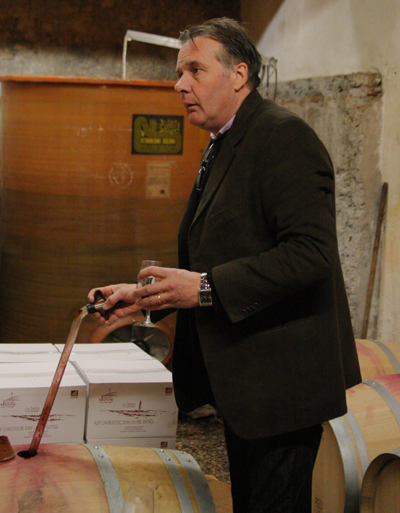
I've downloaded the French language app to my iPhone and buried my nose in more than a few articles on organic wine. Next week I'll be attending the 19th Millesime Bio wine trade show on organic wines in Montpellier, France.

The Millesime Bio brings together wineries and members of the worldwide distribution network in a private trade fair. This year organizers expect 600 exhibitors from countries all over the world, drawing some of the world's leading wholesalers, brokers, wine merchants, sommeliers, caterers, and importers.

And like any such show, there will be a small number of wine journalists there as well. I will be attending, with a group of Northern European wine journalists, as guests of The Inter-professional Association of Organic Wines from Languedoc-Roussillon.

France's often overlooked Languedoc-Roussillon region, in southern France, is one of the leading organic grape-growing areas in the world. The region has 50,000 hectares under organic prodcution in 2010. That's 124,000 acres for you non-metric types.

Exhibitors pouring their wines will come from all over the world. The annual gathering also includes presentations and talks on organic wine laws and growing practices.

I'll have more later in the week. But I do intend to update throughout my time in France on Twitter, Facebook, and nightly updates here.

I'm blessed to have Veronique Raskin of The Organic Wine Company in San Francisco and Paul Chartrand of Chartrand Imports helping make the trip possible and arranging a few big highlights. The conference runs Jan. 23-25, but Raskin and Chartrand have arranged for me to visit three wineries on Thursday of that week before returning. I'll visit with founders of the Languedoc organic movement and the AIVB president.

It's quite exciting to visit southern France and be immersed in the worldwide discussion on organically grown grapes.

Send comment or questions to: hewitthoward@gmail.com